The Spectator · No. 435 · Saturday, July 19, 1712
The Female Cavalier
A lady in a hat and feather rides the Worcestershire plains. Sir Roger’s tenant cannot decide how to address her.
Open the sheetNo. 435 · Saturday, July 19, 1712
On Female Extravagancies
Joseph Addison, signed C.
Nec duo sunt, at forma duplex, nec femina dici
Nec puer ut possint, neutrumque et utrumque videntur.
Ovid, Metamorphoses IV.378
Both bodies in a single body mix, a single body with a double sex.
MOST of the Papers I give the Publick are written on Subjects that never vary, but are for ever fixed and immutable. Of this Kind are all my more serious Essays and Discourses; but there is another Sort of Speculations, which I consider as occasional Papers, that take their Rise from the Folly, Extravagance, and Caprice of the present Age. For I look upon myself as one set to watch the Manners and Behaviour of my Countrymen and Contemporaries, and to mark down every absurd Fashion, ridiculous Custom, or affected Form of Speech, that makes its Appearance in the World during the Course of my Speculations. The no sooner began to swell, but I observed its Motions. The had not Time to muster themselves before I detected them. I had Intelligence of the the very first Time it appeared in a publick Assembly. I might here mention several other the like contingent Subjects, upon which I have bestowed distinct Papers. By this Means I have so effectually quashed those Irregularities which gave Occasion to them, that I am afraid Posterity will scarce have a sufficient Idea of them to relish those Discourses which were in no little Vogue at the Time they were written. They will be apt to think that the Fashions and Customs I attacked were some fantastic Conceits of my own, and that their great Grandmothers could not be so whimsical as I have represented them. For this Reason, when I think on the Figure my several Volumes of Speculations will make about a hundred Years hence, I consider them as so many Pieces of , where the Weight will be regarded, but the Fashion lost.
AMONG the several Female I have already taken Notice of, there is one which still keeps its Ground. I mean that of the Ladies who dress themselves in a Hat and Feather, a and a , or at least tie up their Hair in a or , in Imitation of the smart Part of the opposite Sex. As in my Yesterday’s Paper I gave an Account of the , I shall here take notice of this mixture of two Sexes in one Person. I have already shewn my Dislike of this Immodest Custom more than once; but in Contempt of every thing I have hitherto said, I am informed that the Highways about this great City are still very much infested with these .
I remember when I was at my Friend ’s about this Time Twelvemonth an of this Order appeared upon the Plains which lay at a distance from his House. I was at that same Time walking in the Fields with my old Friend; and as his Tenants ran out on every side to see so strange a Sight, Sir ROGER asked one of them who came by us what it was, to which the Country Fellow reply’d, ’Tis a Gentlewoman, saving your Worship’s Presence, in a Coat and Hat. This produced a great deal of Mirth at the Knight’s House, where we had a Story at the same Time of another of his Tenants, who meeting this Gentleman-like Lady on the High-way, was asked by her whether that was , the Honest Man seeing only the Male part of the , replied, Yes, Sir; but upon the second Question, whether Sir ROGER DE COVERLY was a Married Man, having dropped his Eye upon the , he changed his Note into No, Madam.
HAD one of these appeared in ’s Days, with what an indignation should we have seen her described by that excellent Satyrist. He would have represented her in her Riding Habit, as a greater Monster than the . He would have called for Sacrifice or Purifying Waters, to expiate the Appearance of such a Prodigy. He would have Invoked the Shades of or , to see into what the Roman Ladies had transformed themselves.
For my own Part, I am for treating the Sex with greater Tenderness, and have all along made use of the most gentle Methods to bring them off from any little Extravagance into which they are sometimes unwarily falling. I think it, however, absolutely necessary to keep up the Partition between the two Sexes, and to take Notice of the smallest Encroachments which the one makes upon the other. I hope, therefore, that I shall not hear any more Complaints on this Subject. I am sure my she-Disciples who peruse these my daily Lectures have profited but little by them, if they are capable of giving in to such an Dress. This I should not have mentioned had not I lately met one of these, my female Readers, in , who looked upon me with a masculine Assurance, and cocked her Hat full in my Face.
For my Part, I have one general Key to the Behaviour of the Fair Sex. When I see them singular in any Part of their Dress, I conclude it is not without some evil Intention; and therefore question not but the Design of this strange Fashion is to smite more effectually their male Beholders.
C.
Dotted words open a gloss.
Plate I
Upon the plains of Coverley
’Tis a Gentlewoman, saving your Worship’s Presence, in a Coat and Hat.
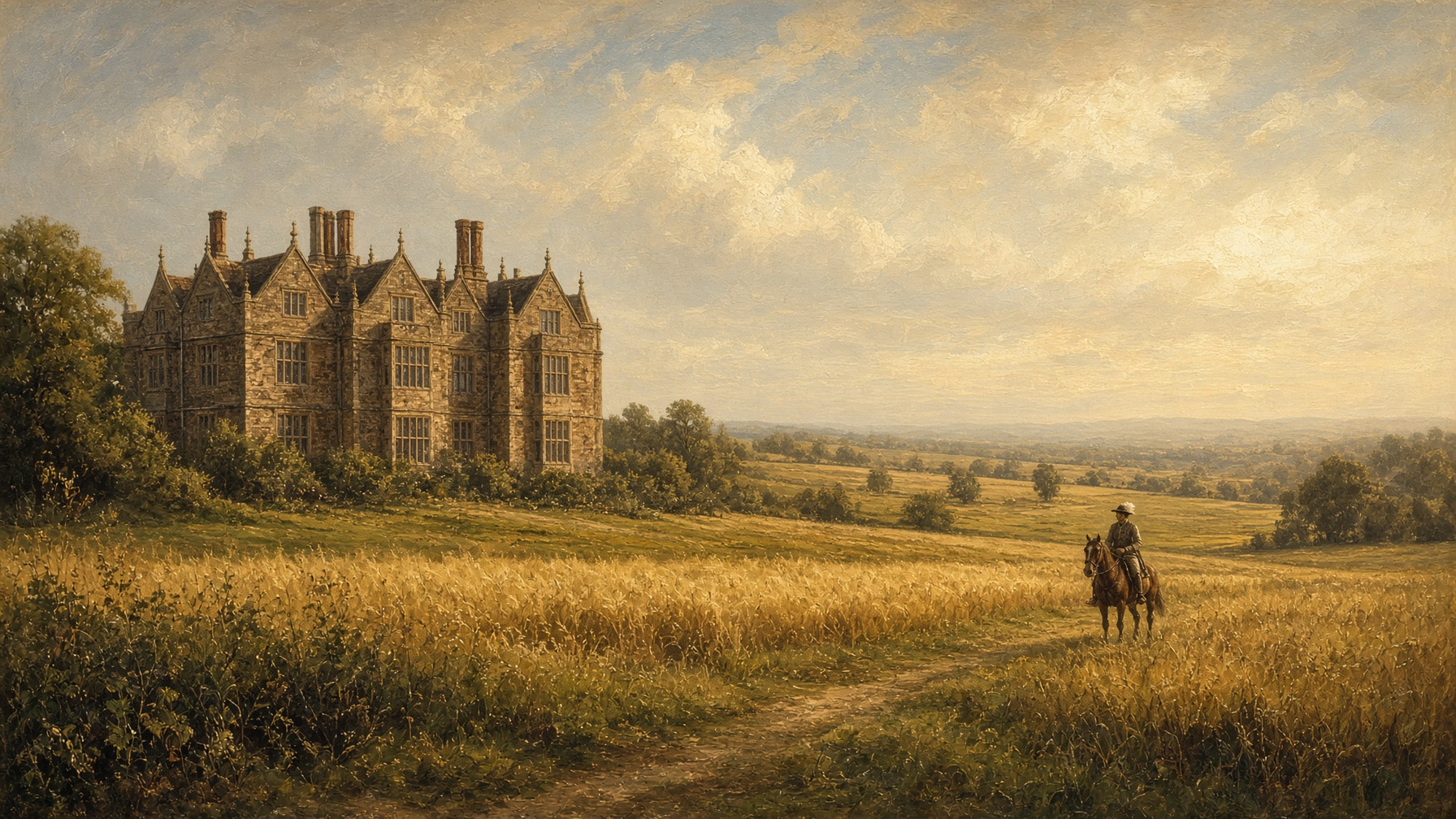
Plate II
The two answers
Two questions on the highway. The first takes the hat; the second takes the skirt. Tap to change the glance.
Yes, Sir.
The honest man, seeing only the male part of the querist.
He sees the hat.
The wardrobe
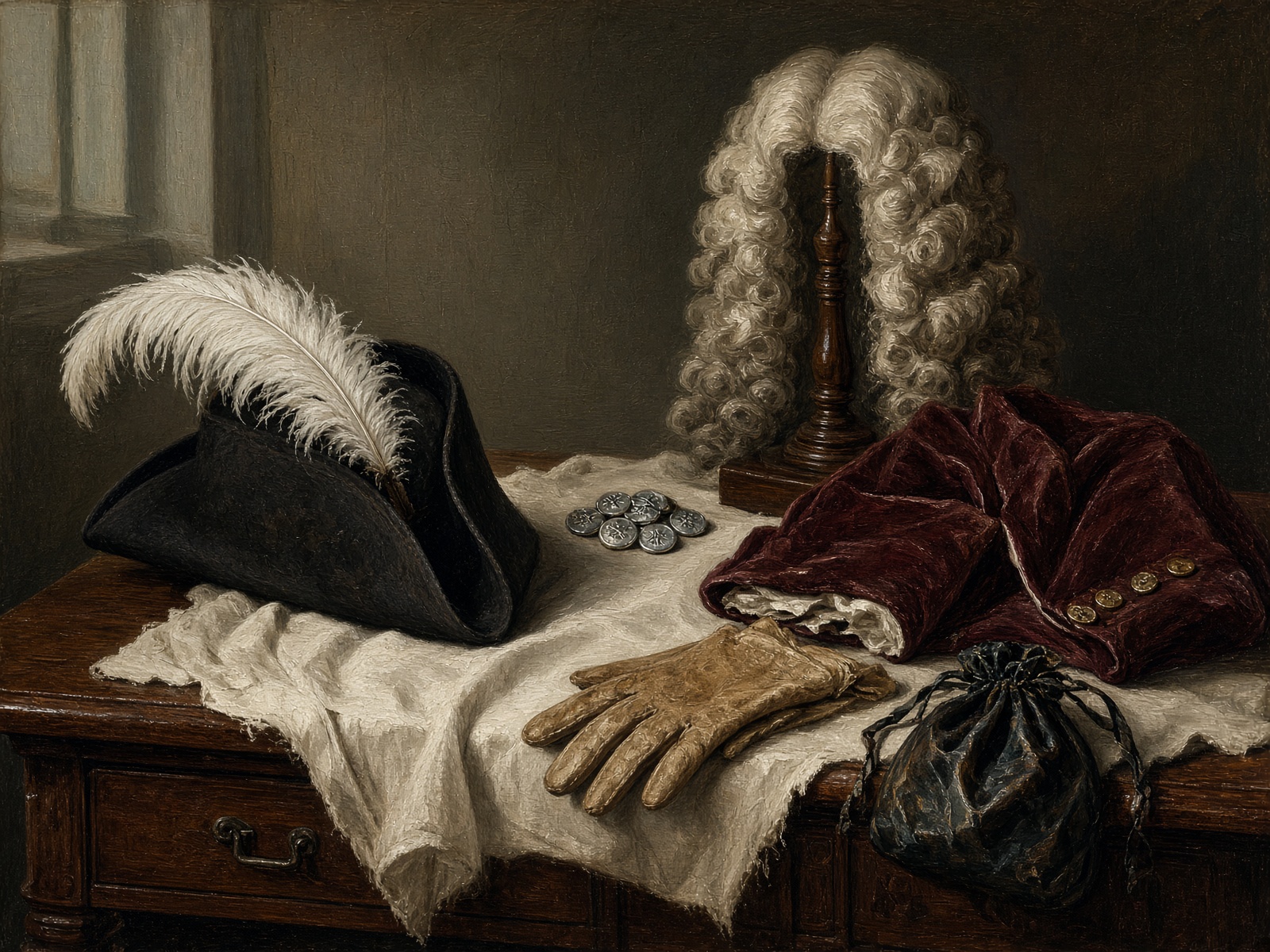
Hat, coat, wig, and the tell
Addison’s inventory is exact: a hat and feather, a riding-coat and a periwig — or hair in a bag — and, fatally, a petticoat.
Cabinet of the habit
A cocked beaver in the officer’s cut, with an ostrich plume. The first thing the Coverley tenant sees — and the reason he answers Sir.
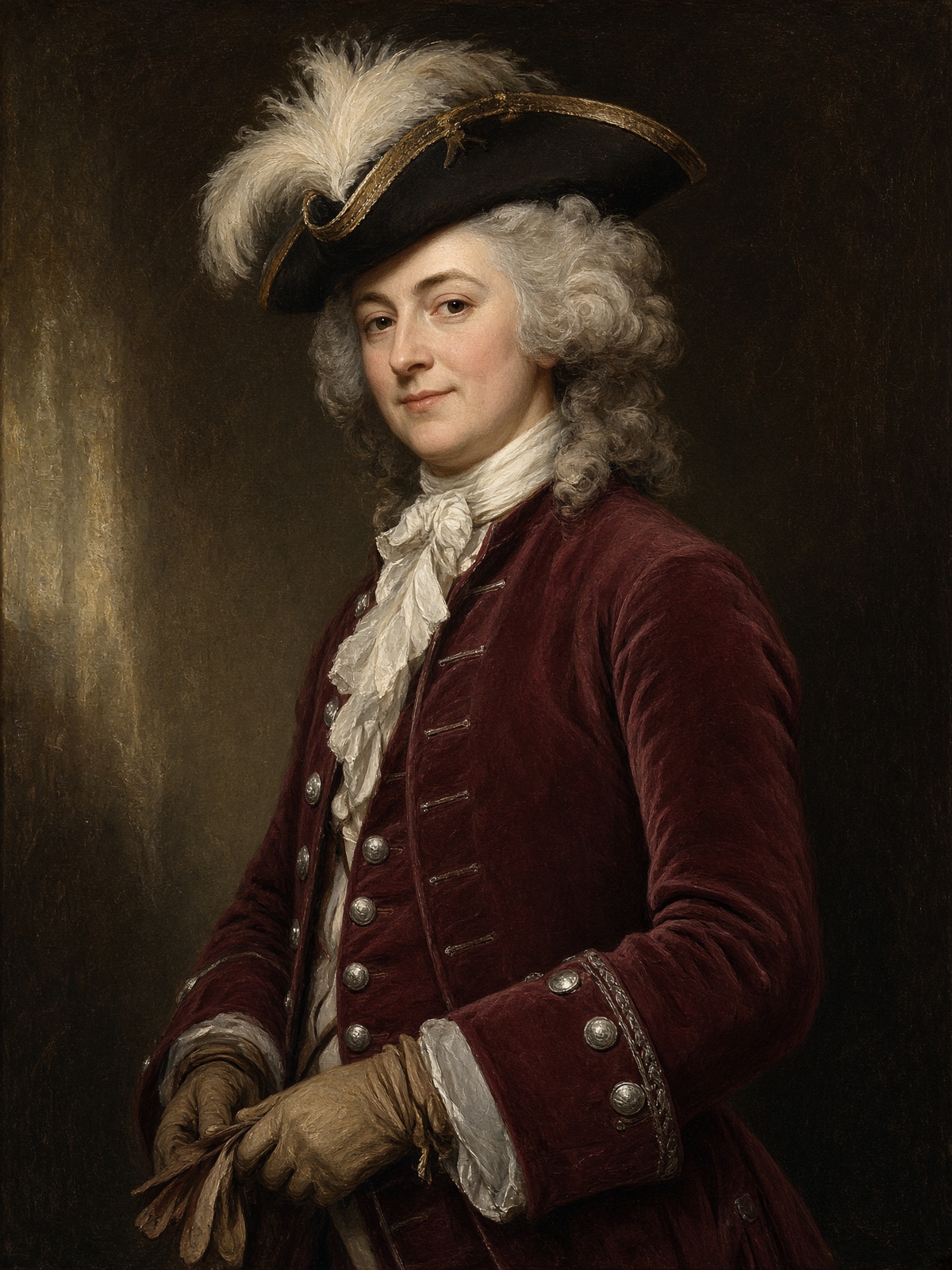
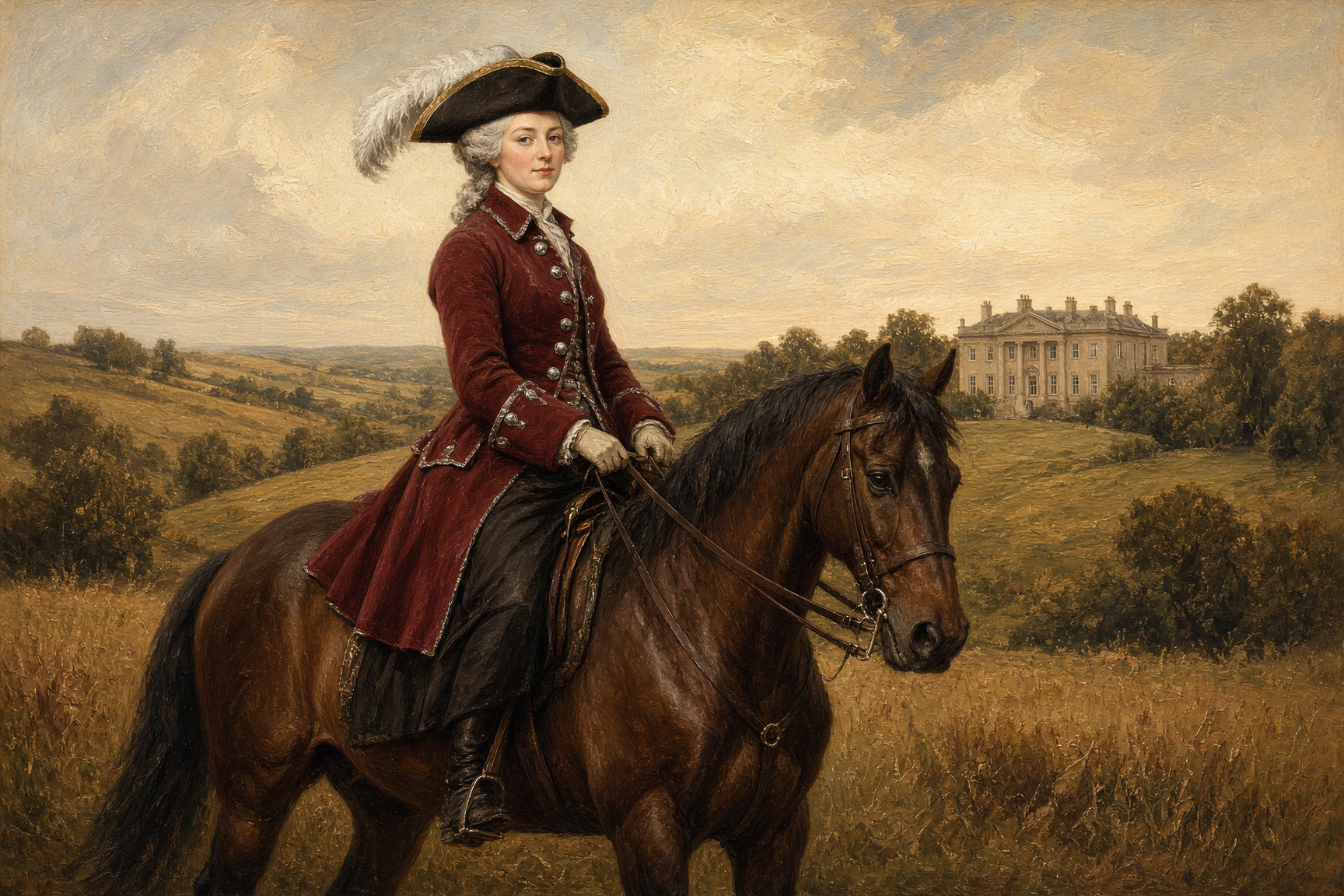
Plate III
A greater monster than the Centaur
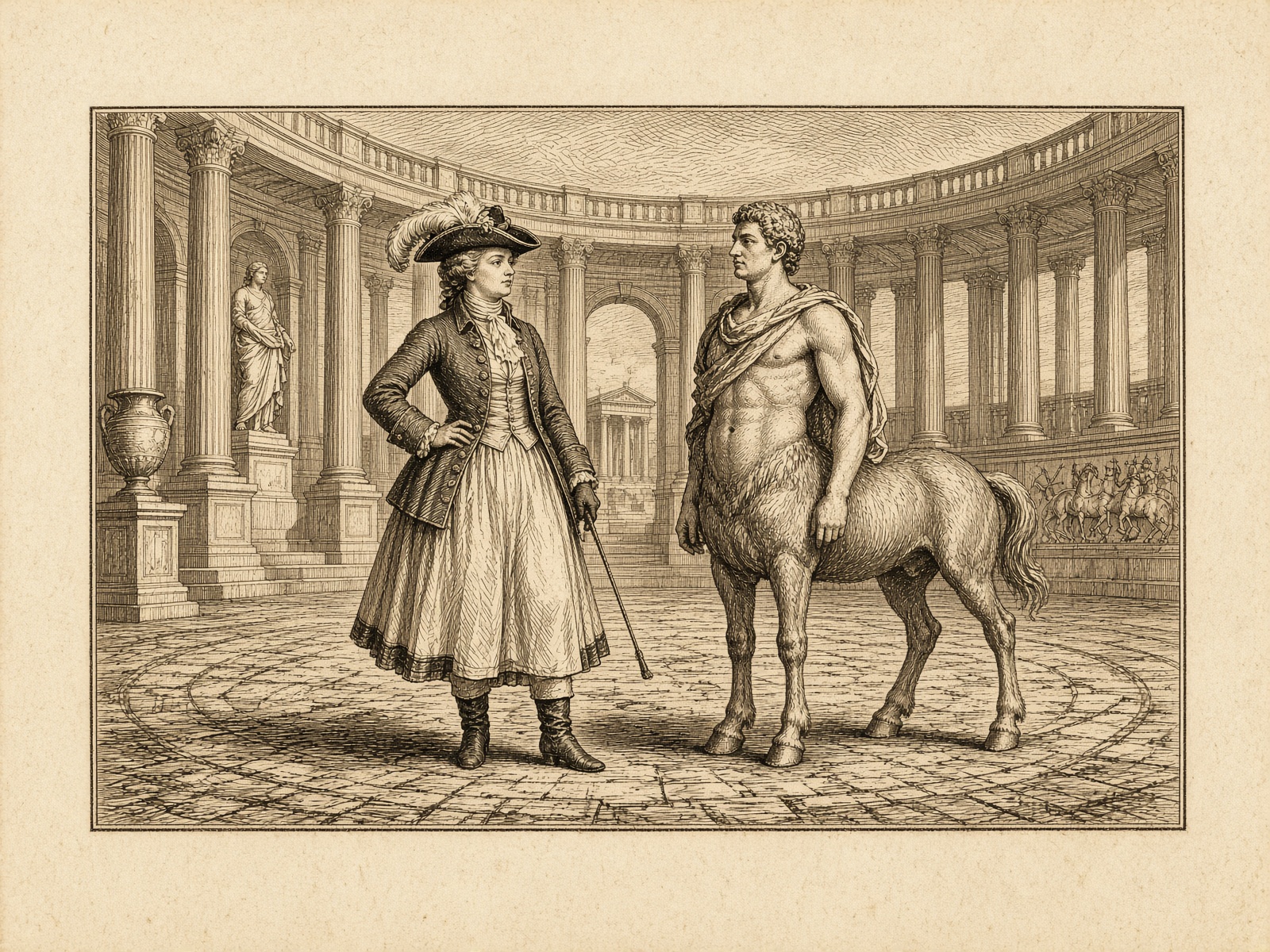
Portia and Lucretia are summoned as witnesses who cannot possibly approve. Addison then declines the full Juvenalian rage — he prefers ‘greater Tenderness’ — and ends, all the same, by reading the cocked hat as a design to smite more effectually their male beholders.
The coffee-house
A few notes for posterity
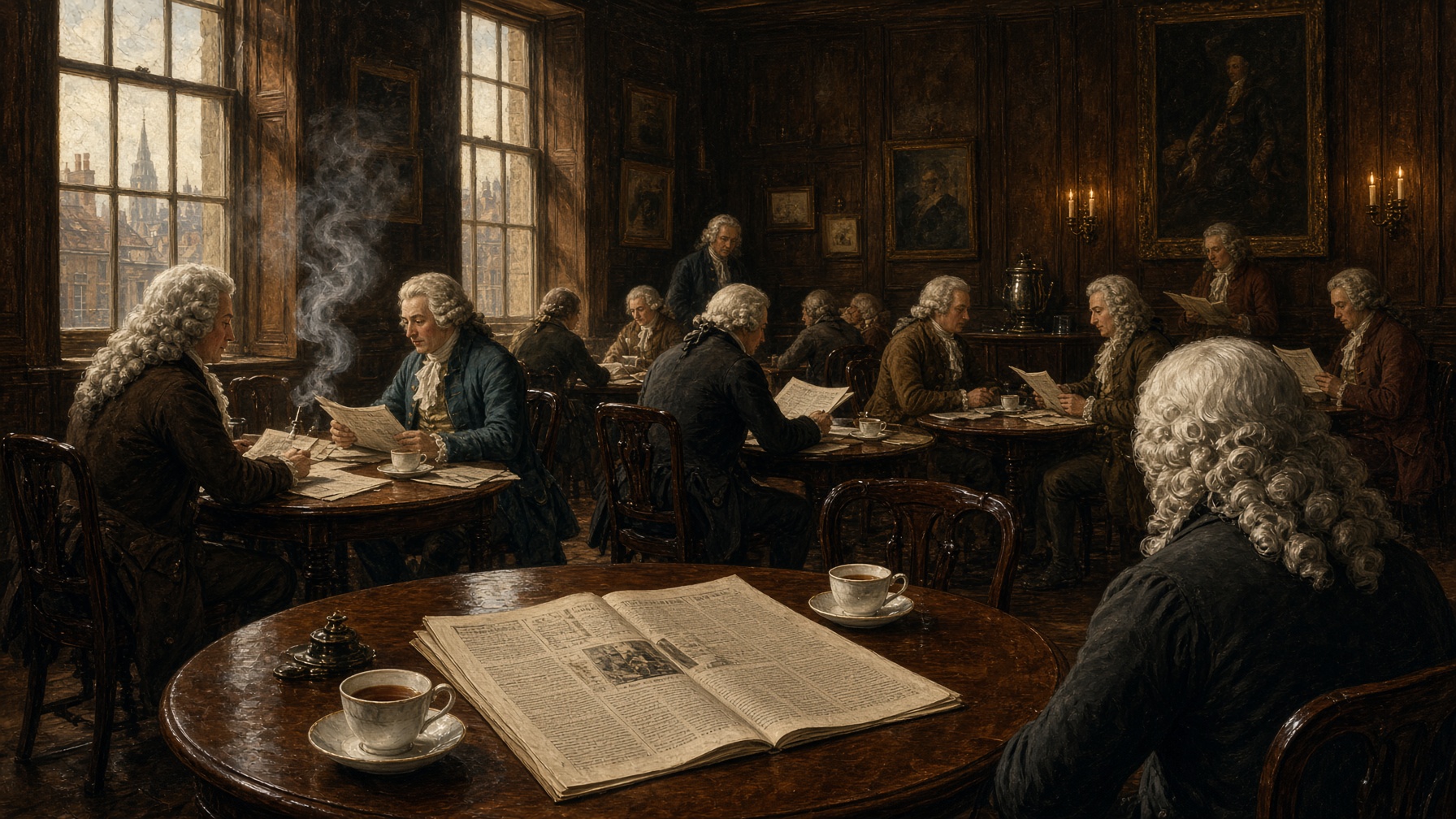
01The motto — Ovid’s double body
The Latin is from Metamorphoses IV, the fountain of Salmacis, where the nymph and Hermaphroditus are fused into one form. Addison prints it over a fashion paper: the riding-habit, he says, is a myth of mixture acted on the road to Coverley.
02Sir Roger, a year ago
The Spectator dates the sighting ‘about this time twelvemonth’ — summer 1711, during the famous visit to Coverley Hall (Nos. 106–132). Tenants still run out of doors. Sir Roger still asks the obvious question, and is answered with a saving of his worship’s presence.
03Yes, Sir. No, Madam.
Two questions, two glances, two addresses. The first takes the hat; the second takes the skirt. Addison’s whole argument is in the tenant’s double take — not a treatise, a piece of country theatre.
04The riding-habit as a real fashion
This was not Addison’s invention. Queen Anne’s horsewomen wore a tailored coat, waistcoat, petticoat, hat and feather. Spectator No. 81 advertised a blue camlet suit ‘never worn but twice’. Nos. 104 and 331 had already scolded the mode; 435 is the third pass, with Sir Roger in it.
05On a period word
Hermaphrodite, in this paper, is a satirist’s name for mixed dress. It is lifted from Ovid and aimed at a cocked hat. Read it as 1712 fashion-war, not as a modern category — the joke that survives is the tenant who cannot choose a title.
06A hundred years hence
Addison feared his papers would become old plate: weight kept, fashion lost. The hoop and the party-patch are gone. The Coverley joke is not. Someone is still being asked, on a highway, to decide what they are looking at.